Gas Sweetening
www.GasSweetening.com


Private investment company interested in acquiring 
Mid-stream Oil and Natural Gas properties, including;

Gas Compression  *  Gas Gathering  *  Gas Processing
Natural Gas Treating * Gas Sweetening

and 

Upstream Oil and Gas Properties, including;

Stranded Gas  *  Stranded Oil


Principals only are welcome to send 
an introductory email describing their property to:

info@GasSweetening.com

or

info@OilAndNaturalGas.net


Products and Services:
Some provided by affiliates or strategic partners

Alternative Fuel Engine
www.AlternativeFuelEngine.com

Amine Plants
www.AminePlants.com

Anaerobic Digester
www.AnaerobicDigester.com

Anaerobic Digesters
www.AnaerobicDigesters.com

B100 Biodiesel
www.B100Biodiesel.com

Best Available Control Technology
www.BestAvailableControlTechnology.com

Biomass Gasification
www.BiomassGasification.com

Biogas Association
www.BiogasAssociation.com

Biogas Conference
www.BiogasConference.com

Biogas Magazine
www.BiogasMagazine.com

Biogas Plant
www.BiogasPlant.com

Biogas to Biomethane
www.BiogasToBiomethane.com

Biomass Gasification
www.BiomassGasification.com

Biomethane
www.Biomethane.com

Carbon Dioxide Emissions
www.Carbon
DioxideEmissions.com

Carbon Emissions
www.CarbonEmissions.com

Carbon Free Energy
www.CarbonFreeEnergy.com

Clean Combustion
www.CleanCombustion.com

Clean Power Generation
www.CleanPowerGeneration.com

Casinghead Gas
www.CasingheadGas.com

Cogeneration
www.Cogeneration.net

Compressed Biomethane
www.CompressedBiomethane.com

Compressed Natural Gas
www.CompressedNaturalGas.net

Controls Engineering
www.ControlsEngineering.com

Diesel to Biodiesel
www.DieselToBiodiesel.com

Diesel to Natural Gas
www.DieselToNaturalGas.com

Dual Fuel Engine
www.DualFuelEngine.com

EcoGeneration
www.EcoGeneration.com

Engine Sales And Service
www.EngineSalesAndService.com

Enhanced Oil Recovery
www.EnhancedOilRecovery.com

Exploration and Production
www.ExplorationAndProduction.net

Flare Gas Recovery
www.FlareGasRecovery.com

Fuel Gas
www.FuelGas.net

Fuel Gas Booster
www.FuelGasBooster.com

Fuel Gas Boosters
www.FuelGasBoosters.com

Fuel Gas Compressor
www.FuelGasCompressor.com

Fuel Gas Compressors
www.FuelGasCompressors.com

Gas Compression
www.GasCompression.net

Gas Compressor Rental
www.GasCompressorRental.com

Gas Compressor Rentals
www.GasCompressorRentals.com

Gas Compressor Sales
www.GasCompressorSales.com

Gas Compressors
www.GasCompressors.net

Gas Dehydration
www.GasDehydration.com

Gas Gathering
www.GasGathering.com

Gas Processing
www.GasProcessing.net

Gas Sweetening
www.GasSweetening.com

Glycol Dehydration
www.GlycolDehydration.com

Greenhouse Gas Emissions
www.GreenhouseGasEmissions.com

Helium Recovery
www.HeliumRecovery.com

H2S Removal
www.H2SRemoval.com

Heater Treater
www.HeaterTreater.com

Landfill Gas To Energy
www.LandfillGasToEnergy.com

Liquefied Natural Gas (LNG)
www.LiquefiedNaturalGas.net

Liquefied Petroleum Gas (LPG)
www.LiquefiedPetroleumGas.net

Methane Recovery
www.MethaneRecovery.com

Natural Gas Engine
www.NaturalGasEngine.net

Natural Gas Engines
www.NaturalGasEngines.net

Natural Gas Liquids (NGL)
www.NaturalGasLiquids.net

Natural Gas Marketing
www.NaturalGasMarketing.net

Natural Gas Measurement
www.NaturalGasMeasurement.com

Natural Gas Sales
www.NaturalGasSales.net

Natural Gas Treating
www.NaturalGasTreating.com

Natural Gas Vehicle (NGV)
www.NaturalGasVehicle.net

Natural Wastewater Treatment
www.NaturalWastewaterTreatment.com

Net Zero Energy
www.NetZeroEnergy.com

Net Zero Energy Building
www.NetZeroEnergyBuilding.com

Oil and Natural Gas
www.OilAndNaturalGas.net

Oil and Natural Gas Investments
www.OilAndNaturalGasInvestments.com

Onsite Power
www.OnsitePowerGeneration.com

Pollution Free Power
www.PollutionFreePower.com

Renewable Energy Investments
www.RenewableEnergyInvestments.com

Renewable Energy Technologies
www.RenewableEnergyTechnologies.com

Renewable Natural Gas
www.RenewableNaturalGas.com

Reservoir Engineers
www.ReservoirEngineers.com

Selective Catalytic Reduction
www.SelectiveCatalyticReduction.com

Sewage Sludge
www.SewageSludge.com

Stranded Gas
www.StrandedGas.com

Stranded Oil
www.StrandedOil.com

Synthesis Gas
www.SynthesisGas.com

Trigeneration
www.Trigeneration.com

Upstream Oil And Gas
www.UpstreamOilAndGas.com

Vapor Recovery
www.VaporRecovery.net

Vapor Recovery Unit
www.VaporRecoveryUnit.com

Waste To Energy
www.WasteToEnergy.net

Waste To Fuel
www.WasteToFuel.com

Waste to Watts
www.WasteToWatts.com


Advertising inquiries, call or email 
the Renewable Energy Institute:

info@GasSweetening.com


What is Gas Sweetening?

Sulfur exists in natural gas and is known as hydrogen sulfide (H2S).  Natural gas is usually considered "sour" if hydrogen sulfides content exceeds 5.7 milligrams of H2S per cubic meter of natural gas. The process hydrogen sulfide removal from sour gas is commonly referred to as "gas sweetening."
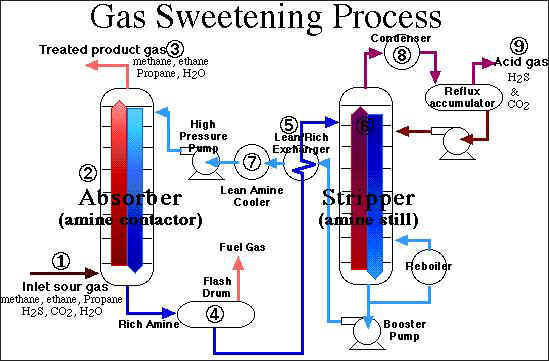


Diagram of the Gas Sweetening Process

The primary process for sweetening sour natural gas is quite similar to the processes of glycol dehydration and NGL absorption. In this case, however, amine solutions are used to remove the hydrogen sulfide. This process is known simply as the 'amine process', or alternatively as the Girdler process, and is used in 95 percent of U.S. gas sweetening operations. The sour gas is run through a tower, which contains the amine solution. This solution has an affinity for sulfur, and absorbs it much like glycol absorbing water. There are two principle amine solutions used, monoethanolamine (MEA) and diethanolamine (DEA). Either of these compounds, in liquid form, will absorb sulfur compounds from natural gas as it passes through. The effluent gas is virtually free of sulfur compounds, and thus loses its sour gas status. Like the process for NGL extraction and glycol dehydration, the amine solution used can be regenerated (that is, the absorbed sulfur is removed), allowing it to be reused to treat more sour gas.

Although most sour gas sweetening involves the amine absorption process, it is also possible to use solid desiccants like iron sponges to remove the sulfide and carbon dioxide.

Sulfur can be sold and used if reduced to its elemental form. Elemental sulfur is a bright yellow powder like material, and can often be seen in large piles near gas treatment plants, as is shown. In order to recover elemental sulfur from the gas processing plant, the sulfur containing discharge from a gas sweetening process must be further treated. The process used to recover sulfur is known as the Claus process, and involves using thermal and catalytic reactions to extract the elemental sulfur from the hydrogen sulfide solution. 

Some of the above information from www.NaturalGas.org with our thanks.



Why Not Go Green? sm
 

Solar Energy Systems Now Available with
Zero Up-front Costs
for Qualified Commercial, Industrial & 
Municipal/Government Clients in 
the U.S., Canada or Caribbean


Upgrade your Brown Building to a Green Building
 
With our Integrated
Solar Trigenerationsm
Net Zero Energy Buildingsm
System

Eliminate your Company's Carbon Emissions  
and Greenhouse Gas Emissions!


More information at the following sites:


www.AnaerobicDigesters.com

www.BiomassGasification.com

www.Biomethane.com

www.BuildingIntegratedPhotovoltaic.com

www.CarbonEmissions.com

www.CarbonFreeEnergy.com

www.CleanPowerGeneration.com

www.Cogeneration.net

www.ConcentratedSolarPower.com

www.ConcentratingSolarPower.com

www.DecentralizedEnergy.com

www.DirectHydrogenFuelCell.com

www.DispersedGeneration.com

www.DistributedGeneration.org

www.DistributedPV.com

www.DistributedSolarGeneration.com

www.EcoGeneration.com

www.GreenhouseGasEmissions.com

www.HydrogenFuelCell.net

www.LandfillGasToEnergy.com

www.MoltenCarbonateFuelCell.com

www.NetZeroEnergy.com

www.NetZeroEnergyBuilding.com

www.PhosphoricAcidFuelCell.com

www.PlasmaGasification.com

www.PollutionFreePower.com

www.PowerPurchaseAgreement.com

www.RooftopPV.com

www.SewageSludge.com

www.SolarEnergySystems.net

www.SolarCogeneration.com

www.SolarPowerAndEnergy.com

www.SolarPowerParks.com

www.SolarTrigeneration.com

www.SolidOxideFuelCell.net

www.SynthesisGas.com

www.ThinFilmPhotovoltaics.com

www.Trigeneration.com

www.WasteToEnergy.net

www.WasteToFuel.com

www.WasteToWatts.com


GreatSkin.com


What is an Amine Plant?

Amine plants are used for "gas sweetening" in the midstream oil and gas sector known as "gas processing." Amine plants provide H2S removal as well as CO2 removal from natural gas and liquid hydrocarbons. The process involves both absorption and chemical reactions. 

We provide amine plant sales and natural gas processing and engineering services.

What are Gas Compressors?

Gas compressors are mechanical device that increase the pressure of a gas by reducing its volume. Gas compressors are responsible for moving the natural gas from the oil or natural gas production well to homes and businesses via natural gas pipelines and gas compression stations.

Gas compression also increases the temperature of the gas during compression.


What is Gas Processing?

Natural Gas Processing plants separate the various hydrocarbons and natural gas liquids from the pure natural gas (methane or CH4) to produce what is known as 'pipeline quality'  natural gas. Natural gas pipeline companies have requirements on natural gas they buy from producers which is why the natural gas processing plants are located where they are, and why they separate the ethane, propane, butane, and pentanes from the methane.  Natural gas liquids or NGLs include ethane, propane, butane, iso-butane, and natural gasoline.

What is Glycol Dehydration?

Glycol dehydration is used in the production and processing of natural gas by using a liquid desiccant that removes water from natural gas and natural gas liquids (NGL). 

Various types of glycols are used in this process including;

TEG is the most commonly used glycol in the natural gas industry.


What is H2S Removal?

H2S, or Hydrogen Sulfide, is a hazardous and corrosive element found in oil and natural gas which needs to be removed from the hydrocarbon before the oil or natural gas can be sold.  The hydrogen sulfides are usually removed in a mid-stream gas processing facility by either iron sponges or amine plants.

What is a Heater Treater?

A "Heater Treater" is used in the oil and gas production process and is used to removes water and gas from the produced oil - and to improve its quality for sale into a crude oil pipeline or for other transport. A heater treater typically combines the following components inside the heater treater:  a heater, free-water knockout, and oil and gas separator.

We provide gas gathering, gas compressors, and other E&P services. 

We are presently acquiring "midstream" energy plants and operations such as natural gas and natural gas liquids - along with the plant assets that treat natural gas - are found between exploration and production of oil and natural gas and the delivery to commercial, residential and industrial customers. Midstream energy assets include over 1 million miles of natural gas pipelines and 500 natural gas processing plants.


What is Natural Gas Treating?

As natural gas is produced from either a natural gas well, or from an oilwell which contains "associated gas," the natural gas must be treated or processed before it can be used at a home or business as a fuel.

Natural gas treating or processing, takes place at gas processing plants to remove the impurities and other hydrocarbons other than the methane itself, or CH4. 

The by-products and impurities of natural gas that must be treated or processed include; ethane, propane, butane, isobutane, pentane, isopentane and higher molecular weight hydrocarbons, as well as H2S or elemental sulfur, carbon dioxide (CO2), water vapor and sometimes helium and nitrogen.


Products and Services:
Some provided by affiliates or strategic partners

Alternative Fuel Engine
www.AlternativeFuelEngine.com

Amine Plants
www.AminePlants.com

Anaerobic Digester
www.AnaerobicDigester.com

Anaerobic Digesters
www.AnaerobicDigesters.com

B100 Biodiesel
www.B100Biodiesel.com

Best Available Control Technology
www.BestAvailableControlTechnology.com

Biomass Gasification
www.BiomassGasification.com

Biogas Association
www.BiogasAssociation.com

Biogas Conference
www.BiogasConference.com

Biogas Magazine
www.BiogasMagazine.com

Biogas Plant
www.BiogasPlant.com

Biogas to Biomethane
www.BiogasToBiomethane.com

Biomass Gasification
www.BiomassGasification.com

Biomethane
www.Biomethane.com

Carbon Dioxide Emissions
www.Carbon
DioxideEmissions.com

Carbon Emissions
www.CarbonEmissions.com

Carbon Free Energy
www.CarbonFreeEnergy.com

Clean Combustion
www.CleanCombustion.com

Clean Power Generation
www.CleanPowerGeneration.com

Casinghead Gas
www.CasingheadGas.com

Cogeneration
www.Cogeneration.net

Compressed Biomethane
www.CompressedBiomethane.com

Compressed Natural Gas
www.CompressedNaturalGas.net

Controls Engineering
www.ControlsEngineering.com

Diesel to Biodiesel
www.DieselToBiodiesel.com

Diesel to Natural Gas
www.DieselToNaturalGas.com

Dual Fuel Engine
www.DualFuelEngine.com

EcoGeneration
www.EcoGeneration.com

Engine Sales And Service
www.EngineSalesAndService.com

Enhanced Oil Recovery
www.EnhancedOilRecovery.com

Exploration and Production
www.ExplorationAndProduction.net

Flare Gas Recovery
www.FlareGasRecovery.com

Fuel Gas
www.FuelGas.net

Fuel Gas Booster
www.FuelGasBooster.com

Fuel Gas Boosters
www.FuelGasBoosters.com

Fuel Gas Compressor
www.FuelGasCompressor.com

Fuel Gas Compressors
www.FuelGasCompressors.com

Gas Compression
www.GasCompression.net

Gas Compressor Rental
www.GasCompressorRental.com

Gas Compressor Rentals
www.GasCompressorRentals.com

Gas Compressor Sales
www.GasCompressorSales.com

Gas Compressors
www.GasCompressors.net

Gas Dehydration
www.GasDehydration.com

Gas Gathering
www.GasGathering.com

Gas Processing
www.GasProcessing.net

Gas Sweetening
www.GasSweetening.com

Glycol Dehydration
www.GlycolDehydration.com

Greenhouse Gas Emissions
www.GreenhouseGasEmissions.com

Helium Recovery
www.HeliumRecovery.com

H2S Removal
www.H2SRemoval.com

Heater Treater
www.HeaterTreater.com

Landfill Gas To Energy
www.LandfillGasToEnergy.com

Liquefied Natural Gas (LNG)
www.LiquefiedNaturalGas.net

Liquefied Petroleum Gas (LPG)
www.LiquefiedPetroleumGas.net

Methane Recovery
www.MethaneRecovery.com

Natural Gas Engine
www.NaturalGasEngine.net

Natural Gas Engines
www.NaturalGasEngines.net

Natural Gas Liquids (NGL)
www.NaturalGasLiquids.net

Natural Gas Marketing
www.NaturalGasMarketing.net

Natural Gas Measurement
www.NaturalGasMeasurement.com

Natural Gas Sales
www.NaturalGasSales.net

Natural Gas Treating
www.NaturalGasTreating.com

Natural Gas Vehicle (NGV)
www.NaturalGasVehicle.net

Natural Wastewater Treatment
www.NaturalWastewaterTreatment.com

Net Zero Energy
www.NetZeroEnergy.com

Net Zero Energy Building
www.NetZeroEnergyBuilding.com

Oil and Natural Gas
www.OilAndNaturalGas.net

Oil and Natural Gas Investments
www.OilAndNaturalGasInvestments.com

Onsite Power
www.OnsitePowerGeneration.com

Pollution Free Power
www.PollutionFreePower.com

Renewable Energy Investments
www.RenewableEnergyInvestments.com

Renewable Energy Technologies
www.RenewableEnergyTechnologies.com

Renewable Natural Gas
www.RenewableNaturalGas.com

Reservoir Engineers
www.ReservoirEngineers.com

Selective Catalytic Reduction
www.SelectiveCatalyticReduction.com

Sewage Sludge
www.SewageSludge.com

Stranded Gas
www.StrandedGas.com

Stranded Oil
www.StrandedOil.com

Synthesis Gas
www.SynthesisGas.com

Trigeneration
www.Trigeneration.com

Upstream Oil And Gas
www.UpstreamOilAndGas.com

Vapor Recovery
www.VaporRecovery.net

Vapor Recovery Unit
www.VaporRecoveryUnit.com

Waste To Energy
www.WasteToEnergy.net

Waste To Fuel
www.WasteToFuel.com

Waste to Watts
www.WasteToWatts.com


Gas Sweetening
www.GasSweetening.com

Advertising inquiries, call or email 
the Renewable Energy Institute:

info@GasSweetening.com


Advertise Here

Advertise Your Company's Amine Plants
and Related Gas Processing Services
at "The" Gas Sweetening Website:

www.GasSweetening.com


Call/email for advertising rates:

info@GasSweetening.com


Enhanced Oil Recovery
www.EnhancedOilRecovery.com

* is the "green" way to produce America's oil
* makes the U.S. energy independent
* ends the need for importing oil from the Middle East
* 240 Billion barrels of oil recoverable through EOR in the USA
* $24 Trillion market opportunity in the U.S.


Enhanced Oil Recovery
www.EnhancedOilRecovery.com

The "Green" Way to 
Produce America's Oil &
Provide for America's Energy Security

EOR Technologies is a new company that seeks to expand the use Enhanced Oil Recovery technologies in the U.S. and to end our dependence on foreign fossil fuels. 

EOR Technologies represents a significant opportunity for oil and natural gas well owners and operators to significantly increase their oil production and revenues through our range of EOR technologies and services.

With the recent plunge in oil prices, our principal investor is now "on the sidelines" and we are seeking a new strategic partner/investor and provider of "turnkey" EOR services. 

In the U.S., Enhanced Oil Recovery represents a $24 Trillion market opportunity according to the U.S. The Department of Energy.  The $24 Trillion figure is based on oil at $100/bbl.  The DOE's studies and reports indicate that the U.S. can recover 240 billion barrels of oil through Enhanced Oil Recovery.  

According to Monty Goodell, Chairman of the Renewable Energy Institute, Enhanced Oil Recovery is the "bridge" we need that provides us the time to transition to home-grown renewable energy and away from fossil fuels. Enhanced Oil Recovery resolves several critical and strategic problems facing our country. First of all, we still need fossil fuel - here in the U.S., we have 240 billion barrels of oil we could recover with Enhanced Oil Recovery technologies according to the Department of Energy.  With oil at $80/barrel, we send over $1 Billion overseas EVERY day to import the oil we need.  By deploying EOR Technologies here in the U.S., we create jobs here instead of in Saudi Arabia, Venezuela, Russia and China, and produce our own energy for our own consumption.  If we started recovering the "stranded oil" from our own oil wells, we would never again need to import another drop of oil from overseas, saving almost $400 billion every year, and creating new jobs.  Enhanced Oil Recovery provides us the time and the bridge, to a more sustainable energy future" said Monty Goodell.

"And, there are environmental benefits and dividends as well," Mr. Goodell adds, "as Enhanced Oil Recovery can remove billions of tons of Carbon Dioxide Emissions from the atmosphere each year.  CO2 is used in Enhanced Oil Recovery to recover the stranded oil and then sequesters the CO2 in oil & gas reservoirs after the stranded oil has been produced.  Through CO2 Injection, the "stranded oil and gas" that would not have otherwise been recovered, is left behind in the oilwell, "sequestered" permanently" according to Mr. Goodell.

We are committed to reducing and eliminating greenhouse gas emissions and carbon dioxide emissions through our sustainable power and energy operations.

In association with the Renewable Energy Institute, affiliate companies and investors, we provide "turnkey" Renewable Energy Project development services that range from initial Engineering Feasibility & Economic Analysis Studies through "turnkey" project development, including construction/installation, start-up and commissioning, Operations & Maintenance, and Long Term Service Agreements for the lifetime of our power plants and energy systems.


EOR Technologies include:

Carbon Capture and Sequestration
www.CarbonCaptureAndSequestration.com


CO2 - EOR
www.CO2-EOR.com


CO2 Flooding
www.CO2Flooding.com


CO2 Injection
www.CO2Injection.com


Enhanced Oil Recovery
www.EnhancedOilRecovery.com


EOR Technologies

www.EORtechnologies.com


Microbial EOR
www.MicrobialEOR.com


Nitrogen Injection
www.NitrogenInjection.com


Radial Jet Enhancement
www.RadialJetEnhancement.com


Stranded Gas
www.StrandedGas.com

Stranded Oil
www.StrandedOil.com


Stranded Oil and Gas
www.StrandedOilAndGas.com


Steam Injection
www.SteamInjection.com


Steam Assisted Gravity Drainage

www.SteamAssistedGravityDrainage.com


Toe to Heel Air Injection

www.ToeToHeelAirInjection.com


For more information about EOR Technologies,  
call/email:  

(832) 758 - 0027

info@EnhancedOilRecovery.com


We Support American Energy Independence, 
and the "Greening" of America's Power and Energy Infrastructure
Through Renewable Energy Technologies

This Will Not Happen Overnight - and Requires a Transition
Period from Fossil Fuels to a Renewable and Sustainable
Power and Energy Economy.

We Believe that Enhanced Oil Recovery is that "Bridge"
to the Future and that Enhanced Oil Recovery
will be the Technology that Makes America Energy Independent
and Employs Hundreds of Thousands of Americans
Recovering America's Oil. 

America Needs to Produce America's Oil,
Without Being Dependent on 
China, Saudi Arabia, Venezuela, Russia or OPEC
for our energy requirements!

Never Again, Will America Be Held Hostage to Oil Sheiks, 
OPEC and From Countries that Don't Like Us.


America Needs America's Oil!
www.AmericaNeedsAmericasOil.com


Drill Baby Drill!
www.DrillBabyDrill.com


____________________________________________________________________________________

Enhanced Oil Recovery 
Through CO2 Injection and 
Carbon Capture and Sequestration


Some of the following information courtesy of the Department of Energy


DOE's Enhanced Oil Recover/CO2 Injection Research Program


Program Goal
Enable enhanced recovery of the nation's "stranded oil" resources. DOE's program focuses on evaluating possible candidate locations for future CO2 injection enhanced oil recovery, utilizing CO2 from industrial sources, as well as geologic sources. 


Crude oil development and production in U.S. oil reservoirs can include up to three distinct phases: primary, secondary, and enhanced oil recovery. During primary recovery, the natural pressure of the reservoir or gravity drive oil into the wellbore, combined with artificial lift techniques (such as pumps) which bring the oil to the surface. But only about 10 percent of a reservoir's original oil in place is typically produced during primary recovery. Secondary recovery techniques to the field's productive life generally by injecting water or gas to displace oil and drive it to a production wellbore, resulting in the recovery of 20 to 40 percent of the original oil in place.

However, with much of the easy-to-produce oil already recovered from U.S. oil fields, producers have attempted several enhanced oil recovery (EOR), techniques that offer prospects for ultimately producing 30 to 60 percent, or more, of the reservoir's original oil in place. 

Three major categories of enhanced oil recovery have been found to be commercially successful to varying degrees:

  • Thermal recovery, which involves the introduction of heat such as the injection of steam to lower the viscosity, or thin, the heavy viscous oil, and improve its ability to flow through the reservoir. Thermal techniques account for over 50 percent of U.S. enhanced oil recovery production, primarily in California.

  • Gas injection, which uses gases such as natural gas, nitrogen, or carbon dioxide that expand in a reservoir to push additional oil to a production wellbore, or other gases that dissolve in the oil to lower its viscosity and improves its flow rate. Gas injection accounts for nearly 50 percent of enhanced oil recovery production in the United States.

  • Chemical injection, which can involve the use of long-chained molecules called polymers to increase the effectiveness of waterfloods, or the use of detergent-like surfactants to help lower the surface tension that often prevents oil droplets from moving through a reservoir. Chemical techniques account for less than one percent of U.S. enhanced oil recovery production.

Each of these techniques has been hampered by its relatively high cost and, in some cases, by the unpredictability of its effectiveness.

CO2 Injection Offers Considerable Potential Benefits


Schematic of CO2 enhanced oil recovery process

Graphic of CO2 enhanced oil recovery. Courtesy of Occidental Petroleum Corp.

The enhanced oil recovery technique that is attracting the most new market interest is carbon dioxide CO2-EOR. First tried in 1972 in Scurry County, Texas, CO2 injection has been used successfully throughout the Permian Basin of West Texas and eastern New Mexico, and is now being pursued to a limited extent in Kansas, Mississippi, Wyoming, Oklahoma, Colorado, Utah, Montana, Alaska, and Pennsylvania.

Until recently, most of the CO2 used for enhanced oil recovery has come from naturally-occurring reservoirs. But new technologies are being developed to produce CO2 from industrial applications such as natural gas processing, fertilizer, ethanol, and hydrogen plants in locations where naturally occurring reservoirs are not available. One demonstration at the Dakota Gasification Company's plant in Beulah, North Dakota is producing CO2 and delivering it by a new 204-mile pipeline to the Weyburn oil field in Saskatchewan, Canada, for CO2 injection there. Encana, the field's operator, is injecting the CO2 to extend the field's productive life, hoping to add another 25 years and as much as 130 million barrels of oil that might otherwise have been abandoned.


Current
CO2-EOR Operations

At present (January 2010), over 48 million metric tons per year of CO2 are used for enhanced oil recovery. Of this total, about 25 percent (12 million tons) is anthropogenic in origin i.e., produced by human activities such as oil refining or fertilizer manufacturing (Trinity 2006). The rest is extracted from naturally occurring deposits.

The CO2 that is used to increase oil production via enhanced oil recovery is an expensive commodity, and for this reason oil companies are motivated to ensure that up to three quarters of the CO2 that is injected remains underground in the oil field. The amount of CO2 sequestered is highly dependent on whether the field is blown-down following any CO2 operations. Further research and development in this area is expected to improve the storage rate to close to 100 percent. Estimates made by the U.S. Department of Energy (DOE) show that depleted oil and gas wells in the United States and Canada have the potential to sequester over 82 billion tons of carbon dioxide in total.


MORE INFO


A turning-point in CO2-EOR advances is a project funded by DOE in the Hall-Gurney field in Kansas that seeks to demonstrate this technology's time has come - providing energy, economic and environmental benefits. A companion project underway in the Hall-Gurney field involves testing the feasibility of 4-D high resolution seismic monitoring of CO2 injection in thin, relatively shallow mature carbonate reservoirs.  Incorporating such time-lapsed monitoring data into CO2-EOR programs could dramatically improve the efficiency and economics of using the technology in many Midcontinent fields.

New breakthroughs in CO2-EOR recovery technology could further enhance oil recovery in Texas and other oil producing states. One DOE-industry partnership project is investigating gravity-stable CO2 injection in the Permian Basin in West Texas, where the goal is to increase oil recovery in the Scurry Canyon Reef field.

DOE Basin-Oriented CO2-EOR Assessments


MORE INFO

In February 2006, a series of technical reports released by the Department on Energy (DOE) Office of Fossil Energy highlight the significant potential for state-of-the-art and advanced oil recovery technologies to significantly contribute to the development of the large volume of remaining undeveloped domestic oil resources in the United States.  Ten basin-oriented assessments- four new, three updated and three previously released- estimate that 89 billion barrels of additional oil from currently "stranded" oil resources in ten U.S. regions could be technically recoverable by applying state-of-the-art CO2-EOR technologies.

Benefits of CO2-EOR

CO2-EOR is a promising method of carbon capture and sequestration for a number of reasons. 

First, the geologic structures that originally contained the oil and natural gas should also permanently contain the injected CO2, provided the integrity of the structures is maintained. From seismic studies, the geologic structure and physical properties of many oil and gas fields are well understood. This, combined with the vast amount of industry experience with gas-injection EOR, provides a knowledge base from which to start researching the sequestration implications of CO2-EOR

Another benefit of CO2-EOR for sequestration purposes is the widespread distribution of depleted and operating oil and gas fields, making it likely that an oil field is near a CO2 source. 

Finally, carbon capture and sequestration from CO2-EOR projects can create offsets resulting in trades in the emerging greenhouse gas market. Many companies are now offering these services and financial transactions to sequester carbon dioxide emissions. One example includes the "forward purchase" of 6 million tons of carbon dioxide emissions (equivalent) and the company then optioned for an additional 3 million tons of CO2 equivalent that resulted from geologic sequestration projects in Texas, Wyoming, and Mississippi, where the carbon dioxide emissions would otherwise have been vented by the natural gas processing plants used for enhanced oil recovery.

Industries Activities

CO2 is specifically processed for most of the 82 projects utilizing CO2 for EOR (Moritis, 2006). The CO2 for these projects is mined from naturally occurring, high-pressure deposits that occur close enough to oil fields to make transmission economically feasible. The following table lists DOE-sponsored projects that utilize anthropogenic CO2 for EOR and additionally promote greenhouse gas emissions reductions, since this CO2 would otherwise be vented to the atmosphere.


U.S. Basins/Regions Studied for Future Potential for CO2-EOR.


Future Potential of EOR/CO2 Reservoirs in U.S. Basins

Additional work has examined potential improvements in CO2-EOR technologies beyond the state-of-the-art that can further increase this potential.  This work evaluating the potential of "game changing" improvements in enhanced oil recovery efficiency for CO2-EOR illustrates that the wide-scale implementation of next generation CO2-EOR technology advances have the potential to increase domestic oil recovery efficiency from about one-third to over 60 percent. 

The presence of an oil bearing transition zone beneath the traditionally defined base (oil-water contact) of an oil reservoir is well established.  What is now clear, and as recently documented in a series of DOE Office of Fossil Energy reports, is that, under certain geologic and hydrodynamic conditions, an additional residual oil zone (ROZ) exists below this transition zone, and this resource could add another 100 billion barrels of oil resource in place in the United States, and an estimated 20 billion barrels could be recoverable with state-of-the-art CO2-EOR technologies.

Large volumes of technically recoverable domestic oil resources remain undeveloped and are yet to be discovered in the United States, and this potential associated with CO2-EOR represents just a portion, albeit large, of this potential. Undeveloped domestic oil resources still in the ground (in-place) total 1,124 billion barrels.  Of this large in-place resource, 430 billon barrels is estimated to be technically recoverable.  This resource includes undiscovered oil, "stranded" light oil amenable to CO2 enhanced oil recovery technologies, unconventional oil (deep heavy oil and tar sands) and new petroleum concepts (residual oil in reservoir transition zones).   


____________________________________________________________________________________________


The Following is a Press Release from the Department of Energy Regarding CO2-EOR

New CO2 Enhanced Oil Recovery Technology 
Could Greatly Boost U.S. Oil Supplies

Reports See Another 89-430 Billion Barrels of Oil Through Carbon Dioxide Injection, Other Advances

Washington, DC – State-of-the-art enhanced oil recovery with carbon dioxide, now recognized as a potential way of dealing with greenhouse gas emissions, could add 89 billion barrels to the recoverable oil resources of the United States, the Department of Energy has determined. Current U.S. proved reserves are 21.9 billion barrels. 

The 89-billion-barrel jump in resources was one of a number of possible increases identified in a series of assessments done for the Department which also found that, in the longer term, multiple advances in technology and widespread sequestration of industrial carbon dioxide could eventually add as much as 430 billion new barrels to the technically recoverable resource. 

Beginning efforts to develop the 89-billion-barrel addition to resources would depend on the availability of commercial CO2 in large volumes. If this oil could be added to the category of proven reserves, the U.S. would have the fifth largest oil reserves in the world behind Iraq, which has 115 billion barrels, based on present estimates; and an additional 430 billion barrels would make it first, ahead of Saudi Arabia with 261 billion barrels. The capture of CO2 from combustion in power generation and other industrial uses is the subject of other research and development programs sponsored by the Office of Fossil Energy. 

Next-generation enhanced recovery with carbon dioxide was judged to be a "game-changer" in oil production, one capable of doubling recovery efficiency. And geologic sequestration of industrial carbon dioxide in declining oil fields was endorsed last year as a potential method of reducing greenhouse base emissions by the Intergovernmental Panel on Climate Change.

Done in compliance with the National Energy Policy Act of 2005 and other Congressional directives, the assessments looked at maximizing oil production and accelerating the productive use of carbon dioxide in all categories of petroleum resources, including as-yet undiscovered oil and the new resources in the residual oil zone. The findings are consolidated in the February 2006 report Undeveloped Domestic Oil Resources: The Foundation for Increasing Oil Production and a Viable Domestic Oil Industry. 

The 430 billion barrel potential was identified in increments of up to 110 billon barrels from applying today's state-of-the-art enhanced recovery in discovered fields – 90 billion in light oil, 20 billion in heavy oil; up to 179 billion barrels from undiscovered oil – 119 billion from conventional technology, 60 billion from enhanced recovery; up to 111 billion barrels from reserve growth – 71 billion from conventional technology, 40 billion from enhanced recovery; up to 20 billion from tapping the residual oil zone with enhanced recovery; and, another 10 billion from tar sands.

The separate assessments and reports contributing to the total resource estimate are: Basin Oriented Assessments, ten assessments of producing U.S. basins and the potential of state-of-the-art enhanced oil recovery; Stranded Oil in the Residual Oil Zone, five reports looking at new resources in the residual oil zone; and, Evaluation of the Potential for "Game-Changer" Improvements in Oil Recovery Efficiency for CO2 Enhanced Oil Recovery, a report on next-generation technology.

______________________________________________________________


The Following is a Press Release from the Department of Energy Regarding CO2-EOR

U.S. Department of Energy • Office of Fossil Energy • Office of Oil and Natural Gas
February 2006

Project Facts
Game Changer Improvements Could Dramatically Increase
Domestic Oil Recovery Efficiency

The report, Evaluating the Potential for “Game-Changer” Improvements in Oil Recovery Efficiency from CO2 Enhanced Oil Recovery, examines how a “step-change” in the efficiency of carbon dioxide-based enhanced oil recovery (CO2-EOR) would help to increase oil production from domestic reservoirs.

Currently available primary and secondary oil production technologies recover only about one-third of the oil in-place in domestic reservoirs, leaving behind massive volumes of oil in the ground (“stranded oil”). Yet, scientific theory, laboratory tests, and selected field projects show that significant increases in oil recovery efficiency are possible. This technical report examines the role that “next generation” CO2-EOR technologies could provide in making “game changer” improvements in domestic oil recovery efficiency and in increasing domestic oil production. Three significant findings emerge from this study:

1. Traditionally practiced CO2-EOR technology will raise overall domestic oil recovery efficiency by only a few percent. The reasons for this relatively modest performance include: (1) CO2-EOR is still only applied in a few domestic oil basins, primarily the Permian Basin; (2) the traditional form of this technology is economic in a relatively small group of geologically favorable oil reservoirs; and, (3) most important, traditionally used CO2-EOR designs provide only a modest, 10% incremental recovery of the original oil in-place.

2. Integrated application of a suite of “next generation” technologies shows that much higher oil recovery efficiencies -- fully two-thirds of the oil in-place -- are feasible from an expanded group of domestic oil reservoirs. The analysis shows that a series of “next generation” CO2-EOR technologies could double the oil recovery efficiency from geologically favorable oil reservoirs and raise overall domestic oil recovery efficiency to over 60% of the original oil in place. In addition, “next generation” technology could extend the miscible CO2-EOR technology to a broader range of domestic oil reservoirs.

3. Successful development and integrated application of “next generation” CO2-EOR technologies could add 40 billion barrels of technically recoverable domestic oil resource (from the first six basins/regions studied). The previously issued six “basin-oriented” CO2-EOR studies reported that 43.3 billion barrels of domestic oil could become technically recoverable with “state-of-the-art” CO2-EOR technology. Successful development and integrated application of “next generation” CO2-EOR technologies could increase this to 83.7 billion barrels, from these six domestic oil basins/areas. (The potential for these “next generation” CO2-EOR technologies for the 10 basins/areas studied as of February 2006 has yet to be examined.)


____________________________________________________________________________________________________________________________

Biomethane: the Perfect Renewable Fuel!
Biomethane Far Better than B100 Biodiesel or E100 Ethanol

As Biomethane is a near perfect fuel, and since Biomethane represents the best of all biofuels in terms of Recycling Carbon, and has the highest Net Energy Balance, and as Biomethane technologies such as Anaerobic Digesters and Biomass Gasification development increases and becomes even more commonplace, one of the fundamental questions is: what is the size of the potential biomass resource supply in the U.S.?

In April 2005, the DOE and the U.S. Department of Agriculture (USDA) co-published a report assessing the potential of the land resources in the U.S. for producing sustainable biomass: Biomass as Feedstock for a Bioenergy and Bioproducts Industry: The Technical Feasibility of a Billion-Ton Annual Supply. Looking at forestland and agricultural land, the two largest potential biomass sources, this study estimates that the U.S. can sustainably produce up to 1.3 billion tons of biomass feedstock by mid-century. This would be enough feedstock to produce 60 billion gallons of B100 Biodiesel and E100 Ethanol with today's technologies.

This study doesn't address the opportunities for Biomethane production from biomass feedstock or Biomass Gasification technologies. Some recent estimates indicate that Biomethane could replace up to 50% of present natural gas consumption in the U.S. and in some countries, such as Iceland, Biomethane already provides 100% of the natural gas requirements.

There are many assumptions in the Billion Ton Study report that impact these estimates, but we believe the estimates reasonably reflect the potential availability and impact of biomass resources.

Of the total estimated resource, the study suggests that forestlands in the contiguous United States can produce approximately 368 million dry tons annually. This projection includes 52 million dry tons of fuelwood harvested from forests and woodlands, 145 million dry tons of residues from wood processing mills and pulp and paper mills, 47 million dry tons of urban wood residues including construction and demolition debris, 64 million dry tons of residues from logging and site clearing operations, and 60 million dry tons of biomass from fuel treatment operations.

Biomass to Biofuels

By "converting" biomass wastes – such as municipal solid waste, sewage sludge, crop residues, energy crops, and manure – into biofuels, this will resolve the energy, environmental and political problems in an economical and environmentally sound manner - that will produce over one million new jobs.

According to Jeff Seisler, Director of the European Natural Gas Vehicle Association, "Biomethane has an outstanding potential as a multifaceted solution to multifaceted social problems: urban and agricultural waste management, water purification, and clean air. Urban and agricultural waste can be processed into usable methane, as can the sewage during the water purification process. Cleaning and compressing the gas for use in vehicles then provides cleaner air than petroleum-consuming vehicles."

Continuing, Mr. Seisler states about Biomethane; "this environmental 'closed loop waste-to-energy-to-fuel used in vehicles that again truck the next load of waste to the energy processing plants-substitutes fossil fuels with a renewable resource and reduces greenhouse gases 100% as compared to over gasoline vehicles (on a well-to-wheel basis).

According to Peter Boisen Chairman, of ENGVA, "various well respected European research institutes now estimate more than three times better fuel output per hectare of land used than if going for ethanol or biodiesel. Sweden currently has a 51% Biomethane share, and Switzerland 37%. France, Norway, Germany and Austria use smaller amounts for vehicles. Iceland, completely without natural gas, uses 100% biomethane in its NGVs," Boisen says.  Continuing, Boisen adds, "China, India, Korea, the Ukraine, Spain and Italy are other examples of countries now starting up projects where Biomethane will be used as a vehicle fuel." 

"With the energy efficiency of the gas production process at 50% to 70% it's hard to think of a more socially acceptable and economic energy value for the transportation sector," Boisen says.

"Governments need to get out of their liquid fuel paradigm to refocus and balance their policies and communications to support the development of a Biomethane infrastructure. In Europe Biomethane has the potential to replace 20% of the petroleum consumed in the transport sector by 2030."

________________________________________________________________________________________________________

Biomethane is the Best of All BioFuels,
Biomethane Can Do It All!


BIOMETHANE FACTS

1.  Biomethane is One of the Most Common and Harmful of All Greenhouse Gas Emissions.

2.  Biomethane is 21 Times More Harmful to the Climate than Carbon Dioxide Emissions. Stated another way, Biomethane Causes Global Warming and Climate Change to Increase 21 Times Faster than Carbon Dioxide Emissions

3.  Biomethane Is A "Renewable Natural Gas."

4.  Biomethane is One of the Easiest and Most Profitable of all Greenhouse Gas Emissions to Recover and Control and is the perfect fuel for heating your home, drying your clothes, cooking your dinner, water heating, and even fueling your car!  Biomethane is also the cleanest of all fuels or biofuels for generating electricity in power plants.

______________________________________________________________________________________________________

California and Sweden Sign Agreement to Jointly Develop 
Biomethane
and Other Renewable Fuels

Thursday, 29 June 2006
Sacramento, California USA and Sweden 

In a ceremony held at the Ministry of the Environment in Stockholm, representatives of the Kingdom of Sweden and the State of California signed an agreement pledging the two governments and their related industries to work together to develop bioenergy, with a particular emphasis on Biomethane

“Through a strong working relationship between its industry and government, Sweden is showing how bioenergy can be developed in a cost-effective manner that benefits its economy and environment. We are extremely pleased to have signed this Memorandum of Understanding (MOU) that will provide a basis for intensified collaboration between Swedish and California officials to develop a thriving bioenergy industry in California,” said Joe Desmond, Undersecretary for the California Resources Agency.

In particular, Sweden has been a global leader in terms of converting biowaste, largely agricultural material and residues, into usable Biomethane. This gas is then used to either generate electricity, residential heating, or as a transportation fuel.

More than 8,000 vehicles in Sweden are powered by a combination of natural gas and Biomethane. The vehicles include transit buses, refuse trucks, and more than 10 different models of passenger cars. There are more than 25 Biomethane production facilities in Sweden and 65 filling stations. The Swedish Biomethane industry has been growing at an annual rate of about 20 percent over the last five years.

According to the Swedish Gas Association, more than 50 percent of the methane used to power Sweden’s natural gas vehicles now comes from biological sources, up from 45% last year. Natural gas vehicle sales in Sweden are increasing at the rate of 25% per annum. 

Sweden was motivated to develop its Biomethane industry because it has no natural gas reserves, to more efficiently manage its waste, and to meet its obligations under the Kyoto Accord. Since Biomethane is developed from methane sources that would normally release into the atmosphere, it’s considered one of the most climate friendly fuels. Methane (and Biomethane) is 21 times more reactive as a greenhouse gas than carbon dioxide (CO2). Sweden is currently meetings its objectives and schedule as outlined in the Kyoto accord.

Biomethane is developed by heating up and breaking down biomaterials in an (Anaerobic Digesters) digester. Among other raw materials, Swedish operators feed their Anaerobic Digesters with slaughterhouse waste, swine manure, and even grassy crops. After the materials breakdown over a 20 day period, technology is then used to remove the impurities and produce Biomethane. Once cleaned-up, Biomethane is 98 percent methane and easily meets the Swedish and California pipeline standards.

The Memorandum of Understanding can be accessed on the California Resources Agency Web site: http://resources.ca.gov/press_documents/CaliforniaSwedenBiofuelsMOU.pdf

_________________________________________________________________________________________________________________


Anaerobic Digesters recover valuable and toxic Biomethane from organic materials and prevents the Biomethane - which has a Global Warming Potential that is 21 times more harmful to our climate than Carbon Dioxide Emissions - from entering the atmosphere.  

Biomethane, which we also refer to as "Renewable Natural Gas" is used as a renewable fuel for our cogeneration and trigeneration power plants. Alternatively, we may sell the Biomethane to a customer and transport it to them from our Anaerobic Digesters via natural gas pipelines.

We believe Anaerobic Digesters and Biomethane represent exciting opportunities for generating renewable natural gas and profits - for multiple reasons:

1.  Anaerobic Digesters take an existing liability and waste (Biomethane) and convert it into an asset and " profit generator."

2.  Anaerobic Digesters mitigate and reverse climate change and global warming by preventing Biomethane to escape into the atmosphere, which is one of the major causes of climate change and global warming.  

Of all Greenhouse Gas Emissions, Biomethane is 21 times more harmful to the environment than Carbon Dioxide Emissions.

3.  Anaerobic Digesters are vital for renewable energy production and helping our country's drive for energy independence. 

4.  EVERY wastewater treatment plant as well as ALL Concentrated Animal Feeding Operations (CAFO's) - IN EVERY COUNTRY - will soon be installing Anaerobic Digesters to prevent Biomethane from entering the atmosphere and help reverse climate change as well as for use as a renewable fuel. Or, they will be replacing their existing inefficient and inferior mechanical wastewater treatment plants, with our "Natural Wastewater Treatment" plants! 

5.  The country of Sweden is the global leader in Biomethane production.  Sweden has identified the Biomethane opportunities and is converting biowaste derived from agricultural material and residues into usable Biomethane. The Biomethane is used to generate clean, renewable electricity, residential heating, and also as a transportation fuel. Biomass sources make up 45% of Sweden’s Biomethane.  Sweden's Biomethane industry has been growing at an annual rate of around 20% over the last five years.  Biomethane powers more than 8,000 transit buses, garbage trucks, and 10 different models of passenger cars in Sweden. Sweden now has more than 25 Biomethane production facilities and 65 filling stations. The country believes that since Biomethane is developed from natural, organic sources that would have been released into the atmosphere, that Biomethane is considered one of the most climate-friendly fuels. Biomethane is 98% methane and easily meets the Swedish and California pipeline standards.

________________________________________________________________________________________________________________________________________

What is "Decentralized Energy"?

Decentralized Energy is the opposite of "centralized energy."  Decentralized Energy energy generates the power and energy that a residential, commercial or industrial customer needs, onsite. Examples of decentralized energy production are solar energy systems and solar trigeneration energy systems.

Today's electric utility industry was "born" in the 1930's, when fossil fuel prices were cheap, and the cost of wheeling the electricity via transmission power lines, was also cheap.  "Central" power plants could be located hundreds of miles from the load centers, or cities, where the electricity was needed. These extreme inefficiencies and cheap fossil fuel prices have added a considerable economic and environmental burden to the consumers and the planet.

Centralized energy is found in the form of electric utility companies that generate power from "central" power plants. Central power plants are highly inefficient, averaging only 33% net system efficiency.  This means that the power coming to your home or business - including the line losses and transmission inefficiencies of moving the power - has lost 75% to as much as 80% energy it started with at the "central" power plant.  These losses and inefficiencies translate into significantly increased energy expenses by the residential and commercial consumers.

Decentralized Energy is the Best Way to Generate Clean and Green Energy! 

How we make and distribute electricity is changing! 

The electric power generation, transmission and distribution system (the electric "grid") is changing and evolving from the electric grid of the 19th and 20th centuries, which was inefficient, highly-polluting, very expensive and “dumb.”  

The "old" way of generating and distributing energy resembles this slide:


The electric grid of the 21st century (see slide below) will be Decentralized, Smart, Efficient and provide "carbon free energy" and “pollution free power” to customers who remain on the electric grid.  The electric grid of the future will be comprised of both Onsite Power Generation plants and "utility scale power plants" that are fueled/powered with Biomass Gasification, Biomethane, Concentrating Solar Power, B100 Biodiesel, Distributed PV, EcoGeneration Systems, Geothermal Power Plants, Synthesis Gas, Rooftop PV, Solar Cogeneration, Solar Energy Systems, Solar Power Parks, Solar Trigeneration and Wind Power Generation  - located at Residential, Commercial, Industrial and City/Municipal Locations. 

Some customers will choose to dis-connect from the grid entirely.  (Electric grid represented by the small light blue circles in the slide below.)

The transmission grid will be upgraded to a "Transmission Superhighway" with green electrons now being wheeled via "High Voltage Direct Current."

Typical "central" power plants and the electric utility companies that own them will either be shut-down, closed or go out of business due to one or more of the following:  failed business model, inordinate expenses related to central power plants that are inefficient, excessive pollution/emissions, high costs, continued reliance on the use of fossil fuels to generate energy, and the failure to provide efficient, carbon free energy and pollution free power

Carbon free energy and pollution free power reduces our dependence on foreign oil and makes us Energy Independent while reducing and eliminating Greenhouse Gas Emissions.

For more information, call us at: 832 - 758 - 0027

* Some of the above information from the Department of Energy website with permission.

_______________________________________________________________________

Amazing Solar Fact!

Did you know that the silicon contained in only one ton of sand, 
and used in manufacturing solar photovoltaic panels, could 
produce as much electricity as burning 500,000 tons of coal?

_______________________________________________________________________

How To Reduce Greenhouse Gas Emissions

You can easily and affordably reduce or eliminate your company's "carbon footprint." 

Did you know that the United States Congress will be passing the S. 2191 "Cap and Trade" Law in 2009?  Did you know that Supreme Court ruled in April (2008) that the EPA already has the authority to regulate Greenhouse Gas EmissionsCap And Trade narrowly passed in the U.S. House of Representatives, and is now in the U.S. Senate, who has threatened to make even greater reductions of Greenhouse Gas Emissions in their final Bill of the Cap And Trade legislation. 

Are you ready for these new regulations?  We can help you get ready!

According to Monty Goodell, MBA, the Founder and Chairman of the Renewable Energy Institute, “Greenhouse Gas Emissions and Carbon Dioxide Emissions will be the world’s biggest commodity market and will probably soon be the world’s largest market, period." In fact,  Mr. Goodell anticipates that Greenhouse Gas Emissions and Carbon Dioxide Emissions will become one of the fasting-growing commodities and markets ever.

Every day, leading companies are spending millions of dollars going "GREEN" and reducing their Greenhouse Gas Emissions.

The Greenhouse Gas Emissions and Carbon Dioxide Emissions Market Potential is staggering!  According to a recent New York Times article, carbon trading is one of the “fastest-growing specialties in financial services.” 

Already, Greenhouse Gas Emissions Trading and International Carbon Trading markets are worth in excess of $50 billion/year. The United Nations expects this market to be valued in excess of $2 Trillion/year by 2012 and others are saying this could easily exceed $5 Trillion/year within the next several years!

DO THE MATH on the Carbon Dioxide Emissions market! 

You may be wondering, how can such a relatively new commodity grow so rapidly?  Here in the USA, 40 billion tons of Carbon Dioxide Emissions are produced every year. At the present price of $50 per ton of carbon dioxide, the Carbon Dioxide Emissions market is valued at $2.0 Trillion (40 billion tons of Carbon Dioxide Emissions x $50.00/ton).

How to Reduce Your Carbon Footprint

Carbon Emissions, Carbon Dioxide Emissions, and Greenhouse Gas Emissions can be reduced or completely eliminated with renewable energy technologies, such as our Solar Energy Systems - including our super high efficiency Solar Cogeneration and Solar Trigeneration energy systems.  Brown buildings can be upgraded in to green buildings and  "Net Zero Energy Buildings" through the products and services that we offer.  

Qualified commercial, government, industrial and municipal clients can affordably have one of our Solar Cogeneration and Solar Trigeneration energy systems installed, with ZERO up-front costs, with our Power Purchase Agreement.  Call (832) 758 - 0027 to learn more and find out if your business qualifies.

______________________________________________________________________________

Why We Need Renewable Energy, 
and a Feed In Tariff, NOW!

Monty Goodell, MBA, Founder and President of the Renewable Energy Institute, along with the Renewable Energy Institute's Scientific Advisory Board, which is comprised of several of our nation's leading experts, engineers, attorneys, professors and universities, is calling for our nation and all 50 states to adopt a Renewable Portfolio Standard (RPS) of at least 25% by 2025.

And even better than a Renewable Portfolio Standard, according to Mr. Goodell, is a "Feed In Tariff," which is the route Germany took, and why they have had such great success in their transition to a solar based economy. The fastest paths to jump-start the renewable energy industry, is through a "Feed In Tariff

A Feed In Tariff is superior to a Renewable Portfolio Standard," according to Mr. Goodell.  "For example, look at Germany's success in their transition to an economy based on the installation of solar energy systems, they adopted a Feed In Tariff, are further north from the Equator than we are here in the U.S., and they are placing solar panels on every rooftop and wind turbine generators throughout their country. They are leading the world in renewable energy technologies, primarily due to their early adoption of a Feed In Tariff"

What is a Feed In Tariff

A Feed In Tariff is a utility rate that is established by a state or federal government, that requires a utility to pay higher electricity rates for green electricity generated by the owners of the solar energy systems, whether that is a homeowner or business owner. Feed In Tariffs shifts the expenses of subsidizing green energy from taxpayers, to electricity ratepayers. Feed In Tariffs also include guarantee that the Feed In Tariffs' artificially higher rates, will continue for periods as long as 25 years.  

Germany's great success for jump-starting the solar energy industry there, first established Feed In Tariffs in 1999.  Germany now has about five times as many solar photovoltaic panels installed as the United States - even though their total combined installations of PV panels  still only account for about 0.5% of the electricity generated there. 

"So, we go with a Feed In Tariff in lieu of a Renewable Portfolio Standard.  Simultaneously, we need to start re-building our national electric grid, and transforming it into 'Transmission Superhighway' or 'Unified Smart Grid' and dramatically increase the nation's power supply as well as implement greater use of 'Energy Efficiency Measures' - also referred to as Energy Conservation Measures.  And we need to implement "real" 'Demand Side Management' programs.  Failure to move in these areas and to do so immediately increases the risks to our country, our national security and the climate" according to Mr. Goodell. 

According to Mr. Goodell, our nation is at a crossroads and we have been 'over the Middle Eastern barrel of their fossil fuels' long enough. We must shift from energy dependence to energy independence and place significant emphasis and investments in our national energy security and lower greenhouse gas emissions.    

Renewable energy, and only renewable energy provides the significant economic and environmental dividends our country now needs.  Preferably, our fledgling renewable energy  industry in the U.S., will be "jump-started" with a Feed In Tariff.  

Some of the economic and environmental dividends that renewable energy will provide our country, include:

According to the Energy Information Administration, the total US primary energy consumption is expected to increase from 100 quadrillion Btu (quads) in 2005 to 131 quads in 2030. However, the renewable electricity generation remains at 9% while use of coal increases 50 percent in 2030 to 57%.  Ethanol use is expected to increase from 4 billion gallons in 2005 to 14.6 billion gallons in 2030, yet that is only about 8% of total gasoline consumption.

In January (2008) the National Climatic Data Center (NCDC) blamed the burning of fossil fuels as a key contributor to global warming and accelerating climate change. The NCDC warned that the rate of the warming is accelerating and that the rise in temperatures over the past 9 years is “unprecedented in the historical record." This was underscored in February (2008) in the consensus report by the Intergovernmental Panel on Climate Change that concluded with near certainty that human activity was the main contributor to global warming.

The renewable energy industry, single-handedly, provides a powerful argument and solutions for these problems. 

Global warming and climate change are symptoms of a sick planet and the results of unrestrained "dumping" of huge amounts of pollution - in the form of carbon dioxide emissions and greenhouse gas emissions into the atmosphere.

The vast majority of carbon dioxide emissions and greenhouse gas emissions comes from "dirty" fossil fuels (coal, oil, and natural gas) used in making electricity at power plants and dirty fuels (gasoline and petroleum diesel) that run our internal combustion engines in our cars, trains, planes, and trucks. Our planet is home to millions and millions of internal combustion engines that run on dirty fossil fuels - whether they are fueled with gasoline for running our cars and lawnmowers or running on diesel fuel in the engines of trucks and ships like the very large crude carriers that transport the crude oil all around the world...... every internal combustion engine that is running on dirty fossil fuels is dumping millions and millions of tons of carbon dioxide emissions and greenhouse gas emissions into our atmosphere - which is aggravating and exacerbating our sick planet - and making manmade climate change and global warming more difficult to resolve through manmade remedies and solutions.

______________________________________________________________________________

Why the U.S. Needs A "Unified Smart Grid" or 
"Transmission Superhighway"

According to Monty Goodell, the Chairman and Founder of the Renewable Energy Institute, "our country desperately needs to upgrade its' national electric grid.  The grid of today is a relic from the past, that is inefficient and costly.  Originally built in the 1930's, it is costing our nation approximately $120 billion every year due to its' outdated and out-lived existence.  The national power grid as designed and built in the 1930's does not have the efficiencies and capabilities to keep pace with the national power grid's demands of today." 

"What we need" according to Mr. Goodell, is what former Vice President Al Gore calls a "Unified Smart Grid" or what we prefer to call a "Transmission Superhighway."

A Transmission Superhighway would be buried underground and "wheels" or transmits the renewable power ("green electricity") from the wind farms of the midwest, and solar farms of the southwest, and geothermal farms of the west, to load centers throughout every corner of the U.S."

According to many estimates, the "Unified Smart Grid" or "Transmission Superhighway" could be built for about $400 billion.  Through its' increased efficiencies, savings and reliability improvements that it will provide, the nation's new "unified smart grid" will be paid in full, in less than 4 years. 

______________________________________________________________________________

For more information, call us at: 832 - 758 - 0027

* Some of the above information from the Department of Energy website with permission. 

______________________________________________________________________________

Greenhouse Gas Emissions Linked to 
the Loss of Polar Bears

Photo courtesy of Alaska Image Library. U.S. Fish and Wildlife Service


______________________________________________________________

“spending hundreds and hundreds and hundreds of billions of dollars every year for oil, much of it from the Middle East, is just about the single stupidest thing that modern society could possibly do. It’s very difficult to think of anything more idiotic then that.”   R. James Woolsey, Jr., former Director of the CIA

Price of Addiction
###
to Foreign Oil


About the Renewable Energy Institute, Climate Science,
Tax-payer Subsidies for Fossil Fuel & Nuclear Industries,
Peak Oil & America's Clear and Present Danger


Monty Goodell, MBA
Founder and Chairman
Renewable Energy Institute

The Renewable Energy Institute (REI) does not take a stand in the debate on global warming, and if there is global warming, is it "anthropogenic" or is it caused by the sun, or the sun's normal cycles.  Or, if there is " climate change," is it "global cooling" caused by the water vapor in the atmosphere? The stand we take is that we need to invest in renewable energy technologies, producing clean, renewable energy that doesn't pollute the planet, and end America's addiction to crude oil from foreign countries where we now spend OVER $1 Billion/day, to buy the oil we need, and some of those suppliers (muslims in foreign countries) take our dollars and make bombs and bullets and send our boys back in body bags. We need to stop this, and put American's back to work, generating "green power and energy" right here at home.

At the Renewable Energy Institute, we are waiting for the "true" scientists who doing the real research, to provide us with the science and answers critically needed to formulate correct policy - and not the phony " scientists" who are following politically-motivated and profit-driven agendas of the United Nations and government leaders. These phony scientists are not interested in conducting real scientific research.  Their very livelihoods are dependent on the government grants to fund their phony research that have pre-determined conclusions before and "research" is conducted.  

Political-interference by governments, governmental agencies, and bureaucrats that hand out billions of tax-payers dollars to phony scientists to conduct "junk science" and research,  expect the conclusions that supports anthropogenic global warming, or climate change. 

When scientists conclude in their research that they find no evidence of anthropogenic climate change or global warming, they are summarily dismissed, and black-balled from their communities and colleagues, and never again receive funding or grants.  Grants and funding by government bureaucrats with politically-driven agendas to "scientists" expecting their pre-determined results and conclusions supporting anthropogenic global warming must stop.

According to the International Energy Agency (IEA), in 2007

And since 1960:

Taxpayers have bankrolled the oil and gas industry, and the coal industry for 100 years now, and the nuclear industry for 50 years, to keep these dirty fuels and energy "cheap." Take away the tax-payer incentives and tax dollars, and we believe the real cost of gasoline, would be similar to the gasoline cost in Europe - $7.00 - $8.00/gallon!

In the meantime, our U.S. Military is spending billions of tax-payer dollars each year protecting the Straits of Hormuz where much of the world's crude oil is produced and shipped through the straits' international shipping lanes.  Each day, hundreds of "very large crude carriers" pass through the Straits of Hormuz carrying oil from OPEC and the Middle-East to the U.S. and many other countries. 

Isn't it time we take some of the tax-payer dollars supporting the nuclear, coal and oil and gas industries, and start incentivizing clean, renewable energy technologies that don't pollute or harm the environment in any way?  Isn't it time that America ends its reliance on non-sustainable energy sources and stop over $1 billion every day, to oil suppliers from foreign countries, and start putting this money in "solar on every rooftop?!?

Mercury Emissions from Coal Fired Power Plants Far More Harmful to the Planet and People than Greenhouse Gas Emissions

Regarding the harm being caused to our planet from energy use, far more harm is being done to the planet, as well as to people and plants and animals, particularly fish, from the mercury emissions from coal fired power plants than from the coal fired power plants' greenhouse gas emissions.  We surmise that if any polar bears have died as a result of an environmental problem, it was more likely from the high levels of mercury in their food chain, than from greenhouse gas emissions

The Renewable Energy Institute is supporting and advancing renewable energy technologies, as well as reducing and eliminating greenhouse gas emissions and the fossil-fuel problems related to America's oil addiction and ending our dependence on foreign oil.  The renewable energy technologies we support are already deemed to be economic, viable and practical. Solutions such as Solar Trigeneration energy systems (see www.SolarTrigeneration.com for more information) for any kind of facility or building - office buildings, shopping centers, data centers, university campuses, etc. 

Since 2003, a Solar Trigeneration energy system has been providing 100% of the power and energy for a 5,300 sq. ft. office building near downtown Los Angeles, and doing so without any connection to the electric grid, whether its 12 noon or 12 midnite!  

The Renewable Energy Institute is also involved in research and advocacy of "Net Zero Energy" (see: www.NetZeroEnergy.com for more information) and "Net Zero Energy Buildings" (see:  www.NetZeroEnergyBuildings.com for more information).  Net Zero Energy Buildings generate as much (or more) energy than they use, and export their excess power to the grid, which we believe needs to be updated into a "Transmission Superhighway."

Climate Change, Global Warming or Global Cooling?

The past 10 years indicates the opposite of "global warming" has occurred - that the "Earths Fever" has and that global cooling has taken place. 

Weather, on a daily basis, or even an annual basis, is not climate, and climate is not weather. 

"Climate change" is always taking place, from one day to the next, and one week to the next, as well as one year to the next. The planet's climate is an ever-evolving, changing and dynamic process.  

Again, researchers and scientists need to refrain from being political, and stay out of politics, and politicians need to stay out of the way of the scientists and researchers, and let them do their work.  Politicians, government leaders and bureaucrats scientists need true and accurate data and climate research from scientists that do not have a political agenda.

In the meantime, as there may still be 30 years of research before there are conclusive answers concerning anthropogenic climate change, can we "risk" 30 years of our children and grand children's future, should there is a link between climate change and greenhouse gas emissions?  Should we not err on the side of caution?

Hubbert's Peak Oil Predictions Now Proving True?

Marion King Hubbert was a geologist and scientist who worked at Shell Oil company's research lab in Houston, Texas.  Hubbert made several important contributions to geology, geophysics and petroleum geology.  Hubbert is most recognized for the "Hubbert Curve" and " Hubbert Peak Theory" which is now referred to as " Peak Oil. 

Hubbert's life work determined that the world has a finite amount of petroleum that can be produced.  (Similarly, there is a finite amount of coal.) Many scientists and engineers believe we have reached Hubbert's "peak oil" limit.  Hubbert's espouses that when 50% of domestic crude oil production has been reached, that there will be such significant upward demand on prices of the limited supplies of oil production, that the U.S. economy will experience severe economic, social, and political turmoil.

Hubbert's Peak Oil predictions have proven to be true and this is validated as the U.S. in the early 1970's produced about 60% of its' oil demand and imported 40%.  That equation has flipped since then, because our domestic oil production has been on the decline since 1970, so now, due to our declining domestic oil production, we have to import 60% of our oil supplies, to meet our country's oil/energy demands.

The Next Oil Shock Could be the "mother" of All Oil Shocks

How severe our economic calamity and next "oil shock" will depend upon a number of factors, including when this occurs, as well as the following:

1.  the dependence of the individual country upon its own crude oil production to meet its energy needs and to subsidize consumer imports; 

2.  the rate of relative decline in crude oil production; 

3.  the degree of difficulty encountered in replacing missing energy inputs; 

4.  the degree to which our country had prepared in advance for this inevitable geological and economic calamity.

Examples of past "oil shocks" and the economic and political calamities that followed:

United States: Our peak crude oil production of domestic oil occurred in 1970; the first "oil shock" and oil crisis followed in 1973 with the Arab/OPEC Oil Embargo.

Iran: Their peak crude oil production occurred in 1974; They had their islamic revolution 1979 that overturned government and replaced it with radical islam.

Soviet Union: Their peak crude oil production was in 1989; what happened next? 
Their country disintegrated and the collapse of the Soviet Union followed in 1991. 

Indonesia: Their peak crude oil production was in 1991; their financial and government crisis followed in 1997.

Iraq: Iraq's crude oil production was in 1989; they then invaded Kuwait (for their oil) in 1991.

Using Mr. Hubbert's predictions, that beginning around 2000  we would see peak (global) oil production, then, if the country's not weaning themselves off of their oil addiction, and had not begun making the switch to renewable energy, that the negative economic and political calamities would soon follow, including ever-increasing prices of energy that is from fossil fuels. 

Now is the time to begin weaning ourselves off of fossil fuels and making the transition to and increasing the use of renewable energy. If you don't believe in climate change, or global warming, GREAT! Join us in the switch to renewable energy and a fossil-free economy!

America's "Clear and Present Danger"

America Has INCREASED its' Dependence on Foreign 
Sources of Energy by 50% Since 1973.

America is even more "addicted" to foreign oil today, than we were in 1973 - 1974 when OPEC, Saudi Arabia and other suppliers from the Middle-East  stopped selling us their fossil fuels, and created a significant blow to our economy.

According to the CIA Fact Book, Every Day, the U.S.:

PRODUCES:      7,460,000 bbls of oil (within its borders)

CONSUMES:   20,800,000 bbls of oil


This Means that 65% of America's Energy Supplies are Now Imported from Suppliers from Foreign Countries.  

Simply put, about 65% of the gasoline in your car's gas tank, comes from a foreign country.

EVERY day, the U.S. must IMPORT over 13 million bbls of oil from foreign countries and foreign suppliers to meet demand. 


At $80/barrel of oil, this also means that $1,040,000,000.00 American Dollars leave our country, EVERY DAY, to foreign countries/suppliers of our fossil fuels, to pay for the energy we need. 


That's $1 Billion EVERY day leaving our economy, and going to support a foreign country's economy. 


Talk about our foreign trade deficit..... nearly $400 Billion each year, leaves our country to pay for our oil addiction and the energy we need.  To be exact, that's $379,600,000,000.00 American Dollars.

This is NOT acceptable.

America needs to quickly transition to Energy Independence. 

Renewable Energy is the Only Way America Can Achieve Energy Independence. 

Millions of new and sustainable American jobs would be created here at home, if we would end our addiction to foreign fossil fuels, and quickly transition to an economy based on renewable energy and renewable fuels, produced here in the U.S.A. 

The good news is that today, America already has all of the Renewable Energy Resources and Renewable Energy Technologies needed to make American Energy Independence a reality. 


Green Energy

According to Monty Goodell, Founder and Chairman of the Renewable Energy Institute, "our increased dependence and reliance on foreign energy supplies represents a Clear and Present Danger to our national security, our economy, and the lives and livelihood of every American. Energy - including the energy we use from imported fossil fuels, is the very "lifeblood" of the American economy as it is for every industrialized country.  An economy dies without it's lifeblood of energy. This Clear and Present Danger we face is far more serious than the problems related to greenhouse gas emissions.  And while greenhouse gas emissions are very serious issue, in the long-term, pales in comparison to America's vital national security interests and America's economic stability in the short term.  For this reason alone, America needs to transition away from its addiction to foreign energy supplies. And America's abundant renewable energy resources such as the energy we receive from the sun, and renewable energy technologies such as concentrated solar power (CSP) plants - can supply 100% of America's power requirements with a concentrating solar power plant measuring 75 miles by 75 miles, located in the Southwest U.S.  By generating America's power from concentrating solar power plants, America resolves its' short-term Clear and Present Danger as it relates to importing its energy from foreign countries, and the long-term problems relating to greenhouse gas emissions."

Continuing, Mr. Goodell states that "too many Americans have forgotten what happened to us in 1973, when the Arabs and OPEC brought the United States economy to a screeching halt during the OPEC Oil Embargo.  This happened because they (mainly the country of Saudi Arabia) disagreed with our foreign policy and is the reason why they "turned off the tap" of our need for their oil supplies. When Saudi Arabia and OPEC stopped the vital flow of oil to our country in 1973, they caused an "oil shock" that severely and negatively impacted our economy. 

Mr. Goodell's question for us to ponder is, "do these countries who sell us 60% of our daily energy requirements, like us and our foreign policy, or might they leverage our addiction to their fossil fuels, and turn off the tap to make us adjust or revise our foreign policy??  Like any addict, America's foreign policy may be held hostage to its addiction, and in this case, our addiction to foreign oil, may over-ride our national interests."

Have American's forgotten the gas shortages and long lines at 
their gas stations to get gas during the Arab Oil Embargo of 1973? 

"Apparently so."  Mr. Goodell states that "in 1973, America was 'addicted' and 'over the barrel' of foreign oil to the amount of 40%.  Forty percent of our energy 'needs' in 1973 came from countries - many of which didn't like us then, and I'm afraid, many of them still don't.  The difference between 1973 and today - is that today we receive 50% MORE foreign oil now than we did in 1973.  And now we know about the problems relating to greenhouse gas emissions that we didn't know then.  America needs to change course, and change course now, in terms of its' energy supplies and how we keep America's economy strong, without the threat of being held hostage to a middle-east tyrant or regime, that could once again, turn on us, and turn off our supply of foreign oil." 

Remember ????


" Sadly," Monty Goodell continues, " most Americans have forgotten the long lines of people waiting in their cars - lined up and waiting for gasoline at their nearby gas station, with lines that were many blocks long.  And, after waiting 4-5 hours, many even waiting overnight in many places, to finally take their turn to fill up their car with gasoline, only to find that the gas station had run out of gas." 

"Let me Repeat.... That was 1973 when we imported 40% of our daily energy requirements in the form of crude oil from overseas, and from foreign countries - and many of these from countries that don't like us.

Today, over 35 years later, America has yet to learn the lesson.  We cannot continue our reliance on energy from foreign countries that supply us with 60% of the crude oil that our refineries use as a feedstock for producing gasoline and diesel fuel for our cars and trucks comes from overseas. 

America is "over the barrel" and it's not our barrel, but the barrels of oil that we are addicted by and owned by other countries.  Why have we not learned the lessons we needed to learn in 1973 when we were cut-off from the vital energy supplies we need? 

Countries like China, are growing rapidly, and have an insatiable need for crude oil. China, with their booming economy, is increasingly growing in its clout and control over international supplies of crude oil - whether they do this through their ability to buy as much oil as they need on a daily basis, or whether they simply but American drilling rigs, technology, and explore and produce oil and gas from their own fields. China, is buying large amounts of oil for their country, and causing upward pricing on declining supplies. What happens if Russia, with all of their oil and natural gas, along with China and Venezuela, with or without the help of OPEC, decided to NOT sell oil to us????

To be sure, greenhouse gas emissions are a problem, and to some, greenhouse gas emissions are also a Clear and Present Danger, but not to the extent that it presents an imminent Clear and Present Danger

America's reliance for 60% of our energy "needs" coming from foreign suppliers is un-acceptable.

The "driver" to get America to begin reducing and eliminating fossil fuel use should be our nation's national security and the welfare and safety of its citizens. And this can all begin with developing and investing in our own renewable energy resources and renewable energy technologies, let's start by putting solar on every rooftop that has a clear and unobstructed view of the Southern sky. See www.RooftopPV.com  or  www.DistributedPV.com  for more information.  Let's create incentives begin with adopting a national "Feed In Tariff" as Germany did in 1990. 

America, we simply do NOT have the luxury of time on our hands.  We need to end our dependence and reliance on foreign fossil fuels, especially from countries that don't like us! We need to rapidly begin expanding renewable energy resources and renewable energy technologies from our vast and abundant renewable energy resources, such as; solar, solar energy systems, solar cogeneration, solar trigeneration, "solar on every roof," waste to energy, waste to fuel, biomass gasification, B100 Biodiesel, Biomethane, Synthesis Gas, geothermal, E100 Ethanol (from sugar cane and NOT from corn), and wind, where it makes economic sense."   


__________________________________________________________________________________________


Products and Services:
Some provided by affiliates or strategic partners

Alternative Fuel Engine
www.AlternativeFuelEngine.com

Amine Plants
www.AminePlants.com

Anaerobic Digester
www.AnaerobicDigester.com

Anaerobic Digesters
www.AnaerobicDigesters.com

B100 Biodiesel
www.B100Biodiesel.com

Best Available Control Technology
www.BestAvailableControlTechnology.com

Biomass Gasification
www.BiomassGasification.com

Biogas Association
www.BiogasAssociation.com

Biogas Conference
www.BiogasConference.com

Biogas Magazine
www.BiogasMagazine.com

Biogas Plant
www.BiogasPlant.com

Biogas to Biomethane
www.BiogasToBiomethane.com

Biomass Gasification
www.BiomassGasification.com

Biomethane
www.Biomethane.com

Carbon Dioxide Emissions
www.Carbon
DioxideEmissions.com

Carbon Emissions
www.CarbonEmissions.com

Carbon Free Energy
www.CarbonFreeEnergy.com

Clean Combustion
www.CleanCombustion.com

Clean Power Generation
www.CleanPowerGeneration.com

Casinghead Gas
www.CasingheadGas.com

Cogeneration
www.Cogeneration.net

Compressed Biomethane
www.CompressedBiomethane.com

Compressed Natural Gas
www.CompressedNaturalGas.net

Controls Engineering
www.ControlsEngineering.com

Diesel to Biodiesel
www.DieselToBiodiesel.com

Diesel to Natural Gas
www.DieselToNaturalGas.com

Dual Fuel Engine
www.DualFuelEngine.com

EcoGeneration
www.EcoGeneration.com

Engine Sales And Service
www.EngineSalesAndService.com

Enhanced Oil Recovery
www.EnhancedOilRecovery.com

Exploration and Production
www.ExplorationAndProduction.net

Flare Gas Recovery
www.FlareGasRecovery.com

Fuel Gas
www.FuelGas.net

Fuel Gas Booster
www.FuelGasBooster.com

Fuel Gas Boosters
www.FuelGasBoosters.com

Fuel Gas Compressor
www.FuelGasCompressor.com

Fuel Gas Compressors
www.FuelGasCompressors.com

Gas Compression
www.GasCompression.net

Gas Compressor Rental
www.GasCompressorRental.com

Gas Compressor Rentals
www.GasCompressorRentals.com

Gas Compressor Sales
www.GasCompressorSales.com

Gas Compressors
www.GasCompressors.net

Gas Dehydration
www.GasDehydration.com

Gas Gathering
www.GasGathering.com

Gas Processing
www.GasProcessing.net

Gas Sweetening
www.GasSweetening.com

Glycol Dehydration
www.GlycolDehydration.com

Greenhouse Gas Emissions
www.GreenhouseGasEmissions.com

Helium Recovery
www.HeliumRecovery.com

H2S Removal
www.H2SRemoval.com

Heater Treater
www.HeaterTreater.com

Landfill Gas To Energy
www.LandfillGasToEnergy.com

Liquefied Natural Gas (LNG)
www.LiquefiedNaturalGas.net

Liquefied Petroleum Gas (LPG)
www.LiquefiedPetroleumGas.net

Methane Recovery
www.MethaneRecovery.com

Natural Gas Engine
www.NaturalGasEngine.net

Natural Gas Engines
www.NaturalGasEngines.net

Natural Gas Liquids (NGL)
www.NaturalGasLiquids.net

Natural Gas Marketing
www.NaturalGasMarketing.net

Natural Gas Measurement
www.NaturalGasMeasurement.com

Natural Gas Sales
www.NaturalGasSales.net

Natural Gas Treating
www.NaturalGasTreating.com

Natural Gas Vehicle (NGV)
www.NaturalGasVehicle.net

Natural Wastewater Treatment
www.NaturalWastewaterTreatment.com

Net Zero Energy
www.NetZeroEnergy.com

Net Zero Energy Building
www.NetZeroEnergyBuilding.com

Oil and Natural Gas
www.OilAndNaturalGas.net

Oil and Natural Gas Investments
www.OilAndNaturalGasInvestments.com

Onsite Power
www.OnsitePowerGeneration.com

Pollution Free Power
www.PollutionFreePower.com

Renewable Energy Investments
www.RenewableEnergyInvestments.com

Renewable Energy Technologies
www.RenewableEnergyTechnologies.com

Renewable Natural Gas
www.RenewableNaturalGas.com

Reservoir Engineers
www.ReservoirEngineers.com

Selective Catalytic Reduction
www.SelectiveCatalyticReduction.com

Sewage Sludge
www.SewageSludge.com

Stranded Gas
www.StrandedGas.com

Stranded Oil
www.StrandedOil.com

Synthesis Gas
www.SynthesisGas.com

Trigeneration
www.Trigeneration.com

Upstream Oil And Gas
www.UpstreamOilAndGas.com

Vapor Recovery
www.VaporRecovery.net

Vapor Recovery Unit
www.VaporRecoveryUnit.com

Waste To Energy
www.WasteToEnergy.net

Waste To Fuel
www.WasteToFuel.com

Waste to Watts
www.WasteToWatts.com


For more information, call or email:

info@AminePlants.com


____________________________________________________________________________________________________________________________________________

Are you doing your part to prevent Climate Change and End America's Reliance on Foreign Energy?

Anaerobic Digester
www.AnaerobicDigester.com


Anaerobic Digesters
www.AnaerobicDigesters.com


Biomass Gasification
www.BiomassGasification.com


Biomethane
www.Biomethane.com


Carbon Dioxide Emissions
www.CarbonDioxideEmissions.com


Carbon Emissions
www.CarbonEmissions.com


Carbon Free Energy
www.CarbonFreeEnergy.com


Clean Power Generation
www.CleanPowerGeneration.com


Greenhouse Gas Emissions
www.GreenhouseGasEmissions.com


Pollution Free Power
www.PollutionFreePower.com


Synthesis Gas
www.SynthesisGas.com


___________________________________________________________________________________________________________________________________________

Our Biomethane, B100 Biodiesel and Synthesis Gas Fuels Generated from our "Waste to Fuel" technologies are Carbon Free Energy and Pollution Free Power solutions that will:


* forever change the way energy is generated and used.

* eliminate or greatly reduce our customer's electric demand charges and electric expenses.

* slow, stop and eventually reverse climate change by reducing and then eliminating anthropogenic greenhouse gas emissions - of which carbon dioxide emissions makes up 80% of all greenhouse gas emissions.

* reduce and eventually eliminate the use of coal and other fossil fuels.

* reduce the need for inefficient and expensive central power plants owned by utility companies. 

* promote energy independence.

* end America's dependence on oil from OPEC and other countries in the Middle-East, Venezuela and end our need for importing natural gas from Russia.

___________________________________________________________________________________________

We support the Renewable Energy Institute by donating a portion of our profits to the Renewable Energy Institute in their efforts to reduce fossil fuel use through renewable energy and their goals to end pollution from Carbon Dioxide Emissions and Greenhouse Gas Emissions

The Renewable Energy Institute is "Changing The Way The World Makes and Uses Energy by Providing Research & Development, Funding and Resources That Create Pollution Free Power, Carbon Free Energy & Renewable Energy Technologies."


  Renewable Energy Institute

"Leading the Renewable Energy Revolution"

www.RenewableEnergyInstitute.org

Email:  info(@)Renewable Energy Institute (.)org


The information contained on this site is copyright protected and 
cannot
be reproduced in any form or manner without our consent.


Advertise Here

Advertise Your Company's Amine Plants
and Related Gas Processing Services
at "The"
Gas Sweetening Website:

www.GasSweetening.com

Call/email for advertising rates:

info@GasSweetening.com


Gas Sweetening
www.GasSweetening.com

info@GasSweetening.com


Renewable Energy Institute

© Copyright 2005 – 2010
All Rights Reserved